USC plays its first game at the new Dedeaux Field tonight at 6 vs. Pepperdine. Admission to all home games this season is free.
- USC’s Homecoming will be Oct. 3 vs. Washington.
- USC has promoted AJ Howard to outside linebackers coach. He was assistant linebackers coach last season. It’s the second internal promotion this week.
- The USC women’s golf team is ranked No. 2 in the nation.
- There will be a screening tonight at 7 at the Crenshaw High School auditorium of the documentary “Unraveling George” on former USC coach George Raveling. Nike is sponsoring the event.
- Here’s a Big Ten-produced 24-team College Football Playoff bracket. USC vs. Arizona in the first round. What a great game!
- And now for some history:
- This week, I finally found an image of a USC football game that I have wanted to see for a long time.
When USC won the national championship in 1962, it almost unexpectedly lost the title on Nov. 17, when 4-4 Navy came to the Coliseum, fresh off a 34-6 loss to Syracuse the week before.
The Trojans were ranked No. 2 in the nation but played their worst game of the season. Navy had a chance to tie the game in the fourth quarter but star fullback Pat Donnelly, who was also an All-American in lacrosse, fumbled at the 1-foot line to preserve the victory for USC.
What made this game special was that it featured quarterback Roger Staubach, one year before he won the Heisman Trophy. He put on a one-man show in the game, passing and rushing for 219 yards (about two-thirds of Navy’s offense).
“That Navy quarterback looked like Red Grange charging around the field,” USC coach John McKay said. “Our pursuit was great but our tackling was poor. You can bet we’ll be having some tackling this week.”
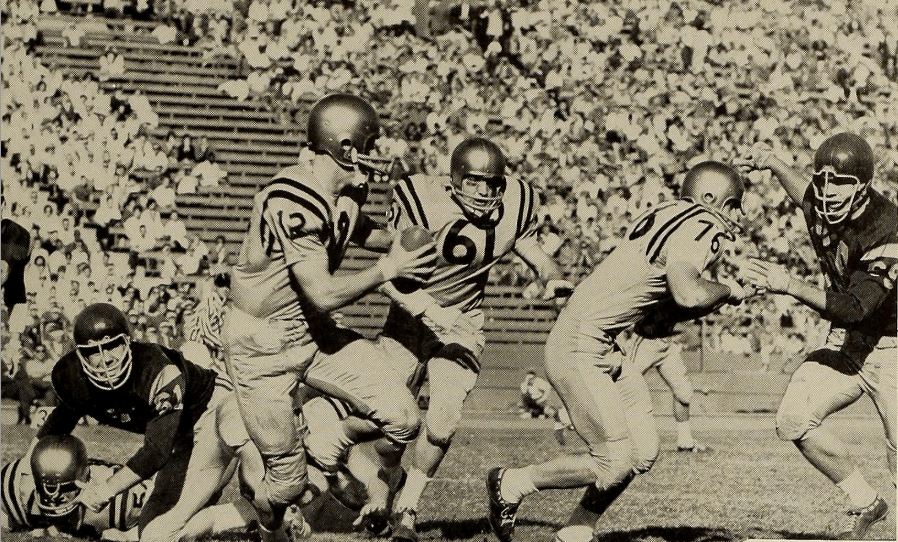
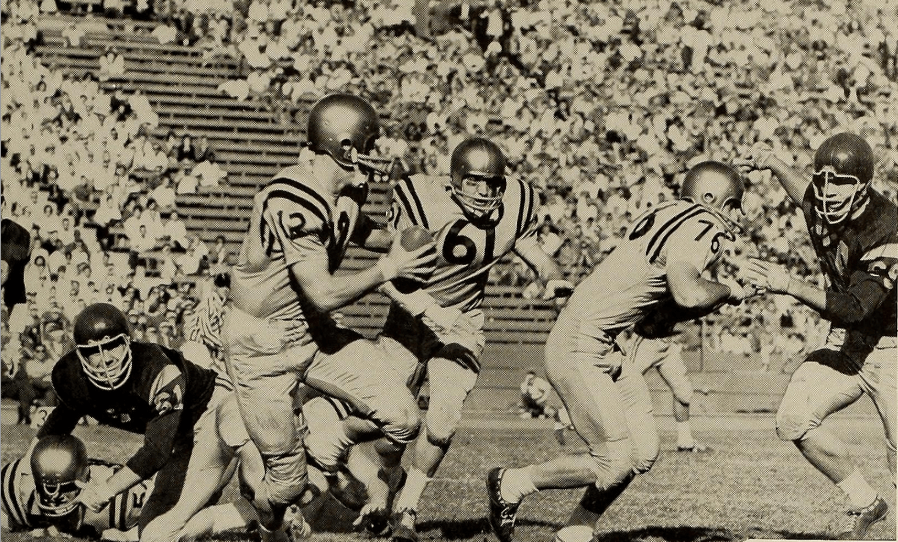
With all this, I’ve never found a photo of Staubach facing the Trojans. Until now.
Here is Staubach with future USC All-American Bill Fisk (left) and all-conference nose guard Pete Lubisich on defense.
It’s a great photo from a memorable moment in Coliseum history.
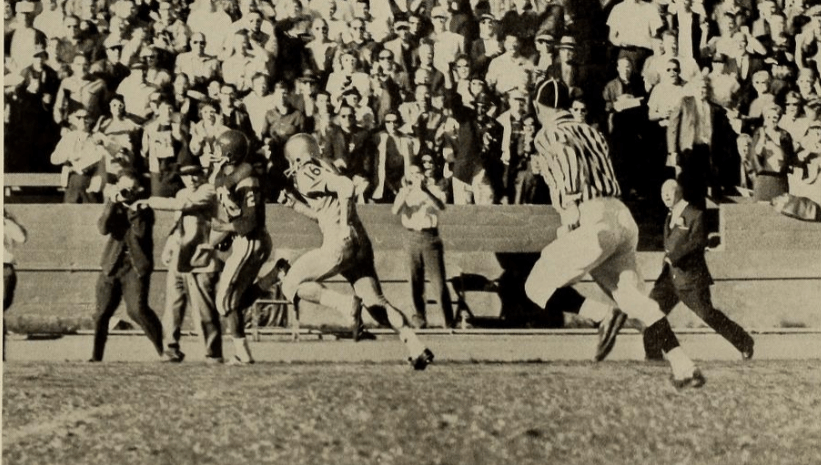
- And in this photo below, USC tailback Willie Brown scores on a 56-yard touchdown run in the third quarter. Brown gained 143 yards in eight carries.
Brown barely touched the ball in the first half. Why? “I don’t know,” McKay said. “I had to remind the boys at halftime that he was on the team and if I did anything today, I’m glad I did that.”
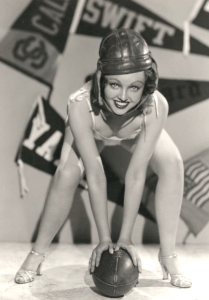
- Actress Lona Andre in a 1934 photo. Note the USC pennant in the upper left corner.
- With baseball season starting, it’s always a good time to remember who ALMOST came to USC in the 1960’s.
- Bobby Valentine and Bill Buckner were friends and supposed to go to USC but the Dodgers signed both. Valentine was selected No. 5 in the first round in 1968 and Buckner was picked in the second round. They actually attended classes at USC.
- Ken Brett was considered by some to be a better prospect (as an outfielder) than his brother, George, and was headed to USC before he signed with the Boston Red Sox as the No. 4 overall pick in the 1966 Major League Baseball draft. The Red Sox made Brett a pitcher instead.
- George Brett was close to going to USC but signed with the Kansas City Royals for $75,000 after being taken in the second round. Brett was a late signee, which made USC think it might get him
- Tim Foli was also headed to USC but became the No. 1 overall pick in the 1968 baseball draft.
- Darrell Evans, who hit 414 home runs in the major leagues, had a locker with his name plate at USC but didn’t have the grades to enter school. So he went to Pasadena City College for a year to get his grades up. Evans played on the PCC basketball team, coached by Jerry Tarkanian. PCC won the state championship and then Evans led the baseball team to the state title. None of that helped his grades, however, and he never went to USC.
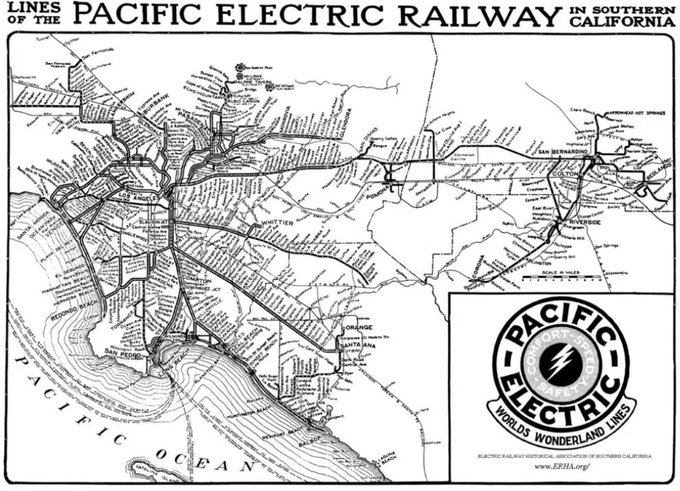
- This map shows that Los Angeles once had the biggest trolley system in the world, connecting 400 main streets.
 InsideUSC with Scott Wolf
Another Friday masterpiece, well done Mr. Wolf!
Interesting in that McKay didn’t even know the name of Roger Staubach when USC played Navy, saying “that Navy QB was running like Red Grange”.
Football was so different then…
LikeLiked by 2 people
In the color coded legend, why name the slightly darker blue “IND”? We all know who THAT is! Just label it accordingly.
LikeLiked by 3 people
Pacific Electric was actually less about public transportation than it was a way to promote real estate development in southern California. The thinking was that people would take the Red Cars to what are today called the exurbs, like what they saw, and buy real estate. Carrying passengers was rarely a money maker for PE, where they made money was on freight, post office contracts, and selling their surplus electricity to southern California municipalities.
Likewise, 100+ years ago the Otis and Chandler families used the L.A. Times to promote development of their real estate holdings in the San Fernando Valley. They partnered with others including Moses Sherman, and there are streets in the valley named after all three. So no, Sherman Way is not named after Peabody’s boy Sherman, nor is Roscoe Blvd. named for Roscoe’s Chicken and Waffles.
LikeLiked by 5 people
KAM: Robert Wagner’s book “I Loved Her in the Movies” reflects on his experiences in Hollywood, including the context of the Los Angeles trolley system during the 1940s, which was a significant part of the city’s public transit before it was stupidly replaced by buses in the 1950s.
DON:The trolley system played a crucial role in connecting various neighborhoods and supporting the film industry at that time.
LikeLiked by 1 person
A 24-team college football playoff would be great because Wiley would qualify for that most years
LikeLiked by 2 people
KAM: A 24-team college football playoff would be great because Riley Coyote would qualify for that most years… but a 64 team playoff would be greater because Riley Coyote would qualify for that every year.
DON: We must lower standards and avoid hard opponents to accommodate Riley Coyote.
LikeLike
Scott, Thanks for the baseball history and the photos of the 1962 Navy game. Before the two platoon system was allowed, players had to play on offense and defense with limited substitution which was mainly for injuries. Until, John McKay figured out a new system that fit the rules of one substitution a quarter. He had three complete teams so he could substitute the entire team three times in a quarter. He had an offensive team, defensive team and a team that played both ways. And, as I have mentioned before, freshmen were not allowed to play on the varsity until their sophomore year. With his substitute plan and “I” formation, Coach McKay was a true innovator. Fight on, Dan, Class of 1962
LikeLiked by 4 people
Thanks Sgt. Joe Friday for the L.A. history. Fight on, Dan, Class of 1962
LikeLiked by 2 people
Roger Staubach and Fran Tarkenton were the first of the “dual threat ” quaterbacks which became the template for future quarterbacks
LikeLiked by 1 person
Scooter,
Great piece. just think if all of those guys had played for Deaduex. The one I don’t undertand is Rick Monday who grew up in Santa Monica and he did not play for SC. Daryel Evans played at Muir High. Stan Smith, the tennis player went to PCC and then SC. Lots of famous people are from Pasadena, including Julia Childs, Sally Fields, Peggy the olympic skater from the 68 or 72 Olympics, Michael Cooper, Tarkanian, Harvey Hyde, and others
LikeLiked by 4 people
Good list PT. I remember Cooper at PHS playing against my high school. Good shooter from the corner but never thought he would become a pro. PCC always had good athletic teams in the 70s and early 80s. Lots of great scientists – Albert Einstein, Edwin Hubbell and Robert Oppenheimer all taught at Cal Tech. I have run into Lucy Jones walking in front of my house with a backpack on a few occasions. Nice lady. And Oscar De La Hoya used to live about a 1/2 mile away in the same area as Bruce Dern. Oscar moved about 5 years ago. Meryl Streep has a vintage mid Century home overlooking the Arroyo Seco and Kristen Wiig lives in the same area.
PT: You left out Jackie and Mack Robinson. Mack finished second to Jesse Owens in the 1936 Olympics. And everyone knows Jackie’s story with the Dodgers. Lots of Dodgers lived in Pasadena.
LikeLiked by 3 people
Sally Field is from Pasadena? She was a classmate of mine at Birmingham High in Van Nuys
LikeLiked by 2 people
I had read that she was. I could be wrong
LikeLiked by 2 people
You are right PT. Sally Field was born in Pasadena. Probably moved to Van Nuys later.
LikeLiked by 2 people
Did you like her, Sparrow? Did you really like her? Really good actress and has the oscar to prove it. Fight on, Dan, Class of 1962
LikeLiked by 1 person
I went to school with Tim Foli….he had just been offered a full scholarship as a QB for McKay but then the Mets picked him. John Vella was in the same class – 1968.
Big smoke coming out of Sacto St….the Hornets are prepared to pay $15 mil to get into the MAC
The MAC just lost No. IL to the Mtn West and that was followed up earlier this week with ND St. leaving to join the Mtn West too.
UTEP is also joining the Mtn. West – that brings the Mtn West to 10 members after losing 5 this past year to the Pac12
LikeLiked by 1 person
The NAVY lineman protecting Staubach look big for 1964. How do those guys fit in a submarine. Takes a lot of ducking.
LikeLiked by 2 people
Thanks Mike
LikeLike
USC 3 Pepperdine 1 Friday 13th February 2026
1st victory and game of the 2026 season
LikeLike
KAM: Riley Coyote sez, ” think it’s pretty clear that the Big Ten and the SEC have separated themselves. I think everybody in college football understands that. “
DON: Except the ACC’s Miami played in the championship game. Riley Coyote fails once again.
LikeLike
To Dan in answer to his Sally Field question– No, I didn’t like her, I barely knew her; those were my bashful days
LikeLike
Good morning Sparrow. I was just quoting Sally at the Academy Awards when she received her Oscar. Evidently she didn’t feel liked, but by whom we do not know. Fight on, Dan, Class of 1962
LikeLike
I don’t like the first round byes for any teams. It makes the playoffs unequal not only for playing time but also potential injuries. The teams that play the extra game have more exposure to injuries. Sixteen would be better than 24 and 32 would be better than 24. I do agree with the elimination of the conference championship games, and all conferences should play the same number of conference games. No exception for ND. Fight on, Dan, Class of 1962
LikeLike
Despite Scott Wolf’s constant negativity towards the coaching staff, promoting Skylar Jones may become a blessing in disguise. Zarnell Fitch would have been a more expensive replacement with a steeper learning and adaptability curve including being less amenable to his former boss old ways. Jones will more or less do everything Patterson wants plus he’s popular with the defensive players. So the defensive guys got part of the cookie that they wanted. Hiring Ed Orgeron would have been stupid and distracting since Ed hasn’t been a position coach in nearly 15 years now.
Can we stop beating the dead horse over the lack of a rivalry game with Notre Dame? It’s like someone needs a Massengil bath or something at this point.
LikeLike
KAM: You need one, Cowardly Gabby aka Charlie Bucket the UCLA Fan aka TebowObama aka The Guy who posts as So Cal’s Wife & Michael Guarino & Buddhakarma &LawyerJohn & Pudly & Plow Horse & steveg49 & DOJ & Scott Wolf & Kathy & Foreskin Thoughts & Frank Young and The Moderator.
DON: Your Bruins just lost by 30 to #2 MICH!
LikeLike
Pigskin, much thanks for the great comments. I really like how you found the reasonable positives with the coaching. Trust in Patterson and his staff, but verify through the games this season. Thanks. Fight on, Dan, Class of 1962
LikeLike
wolfman, why do you insist on provoking the huge “shouldda-couldda-wouldda” crowd at SC?? stick with the present, wolfman! incidentally, how bout a review of the trOXans prospects for ’26??
meanwhile, take a knee, wolfman! i’ll give a quick re-cap of the Gutty Bruins outlook for ’26!! for starters we are el numero uno ranked team for pre-season!! we also have the consensus #1 player in country at shortstop, he’s already called the probable #1 draftee !! so looks like Savage is shooting for another Natty, wolfman!! insofar as the trOJans go, better stick to what couldda been back in the 60’s!!! HAWR HAWR!!
#Yesterday-U
LikeLiked by 1 person